Reaching and Rising: Into the Fullness of His Love

There is a life that begins in Christ and never ends.1 It is the life of faith: a reaching, day after day, for the eternal love He gives us. Not a strained grasping after Someone far away, but a living toward the One who has already drawn near. We belong to Him now. And still the heart leans forward, yearning, stretching through the haze of this present world toward the fullness of His love.2
That posture of reaching is tender and real. It is finding our way by faith when sight is incomplete.3 It is trusting Christ in the things we cannot explain, receiving His love even when we cannot feel beyond the weight of the day. Sometimes our reaching is joyful. Sometimes it is no more than a whispered prayer. But He is present in both.
Here, life is abundant because of the quiet, indwelling work of the Holy Spirit, renewing us day by day.4 We experience that vibrant, living growth right now. Grace is not postponed until eternity. The love of Christ is already given, already at work, already holding us. Transferred into His Kingdom. This is our present reality in regeneration. We already exist in Christ.5
Yet there is a horizon beyond these mortal limits.6 While the life we have now is rich and full of grace, a deeper longing remains: the realization that one day, in the blink of an eye, what we have known by faith will open into sight.7 No more reaching through the haze. No more glimpses interrupted by weariness, grief, or the limitations of our understanding. We will behold Him. The awakening is not the beginning of our existence in Him, but our first full sight of that reality—beyond this dimension, in His presence.8
We who already exist in Christ will experience the fullness of what His love has promised. From seeing through a glass, darkly, to face to face.9 From knowing His presence within this fragile life to standing unhindered in His uncontainable Glory. The love that sustains us now will surround us in a fullness we cannot yet imagine—absolute, unbounded joy.
I believe that in Heaven, in Glory—beyond this dimension of time and space, in that Place where God dwells—Love is tangible. Not merely felt, but encountered as reality. If Glory has weight there, how much more so—Love.10
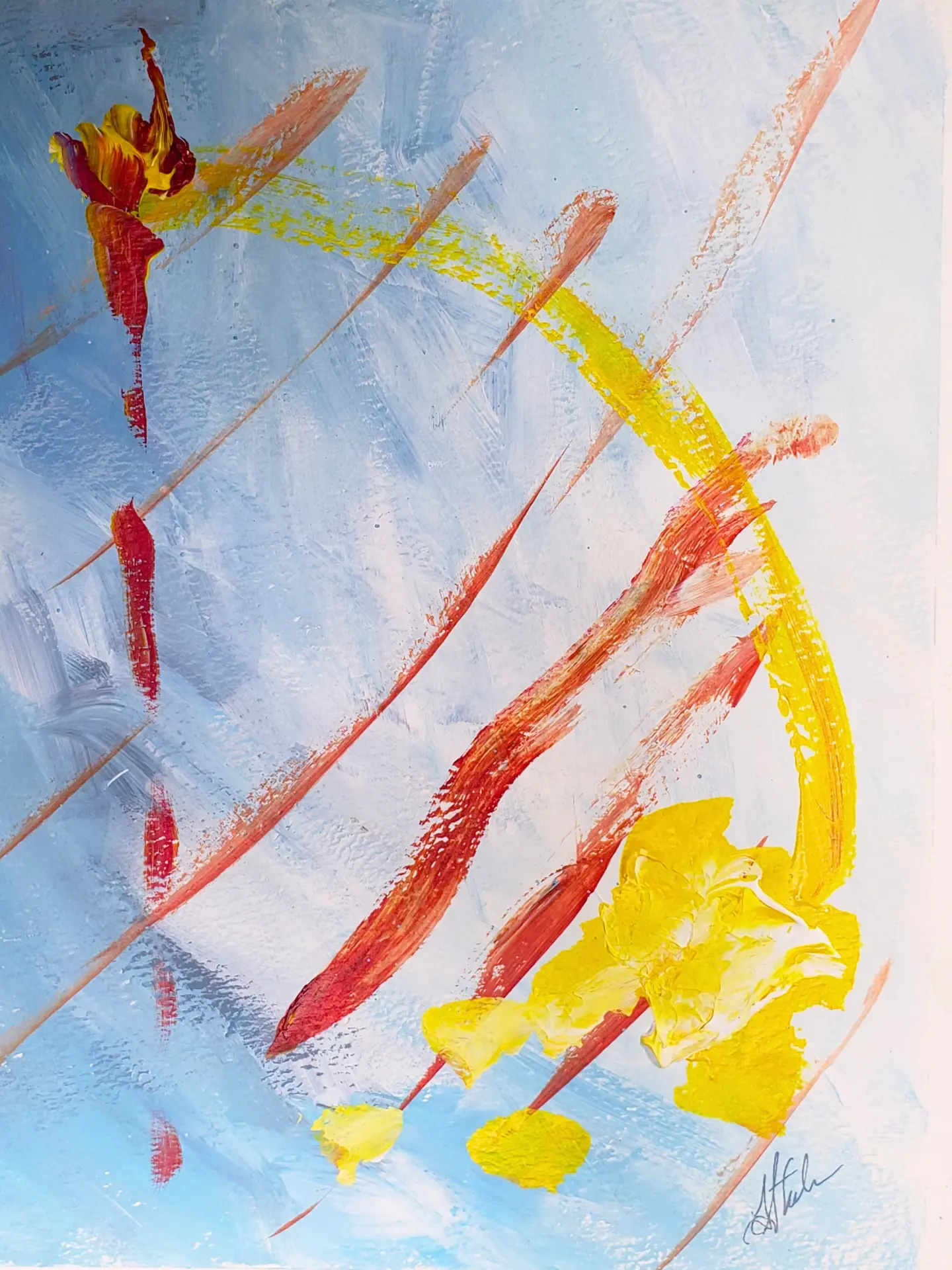
Reaching and Rising give visible expression to that longing. In Reaching, the delicate, translucent movement suggests the soul stretching toward Him through all that remains uncertain. In Rising, the movement becomes bold and unhindered. These are not explanations of eternity. They are expressions of faith in the One who has made it ours.
We are already new creatures in Christ. What awaits is not the beginning of that life, but its unveiling.11 Like a caterpillar awakening from its cocoon into a life of wings and open sky, there is more ahead than our present surroundings reveal. What is hidden is not absent. What is promised is not less real because we have not yet seen it.
For now, we live by faith in Christ, receiving His love and reaching toward its fullness. And one day, in the blink of an eye, we will see. Reaching. And then, Rising.
For those who want to go deeper
1. A life that begins now and never ends. Jesus defines eternal life in terms of knowing God: “And this is life eternal, that they might know thee the only true God, and Jesus Christ, whom thou hast sent” (John 17:3). In John 10:27–30, He says, “I give unto them eternal life; and they shall never perish.” Eternity is not only a length of time ahead of us. The life we receive in Christ is already begun.↩
2. Reaching toward love already given. In Ephesians 3:14–21, Paul prays that believers, already “rooted and grounded in love,” may comprehend its breadth, length, depth, and height, and “know the love of Christ, which passeth knowledge.” This is the reaching described here: not earning His love, but growing into the understanding and experience of it. There is always more to know of a love beyond the limits of our knowing.↩
3. Loving Him before we see Him. “For we walk by faith, not by sight” (2 Corinthians 5:7). Peter describes this present experience beautifully: “Whom having not seen, ye love; in whom, though now ye see him not, yet believing, ye rejoice with joy unspeakable and full of glory” (1 Peter 1:8–9). Incomplete sight does not make the relationship incomplete in its reality. We love Someone we truly know, though we have not yet seen Him.↩
4. Regeneration and daily renewal. Titus 3:5 speaks of salvation through “the washing of regeneration, and renewing of the Holy Ghost.” 2 Corinthians 4:16 describes the ongoing experience: “though our outward man perish, yet the inward man is renewed day by day.” The new birth is not repeated every morning; the Spirit continually renews the life He has given. Our outward frailty and inward growth can exist together.↩
5. Already transferred—and already in Christ. Colossians 1:12–14 gives the foundation: the Father “hath delivered us from the power of darkness, and hath translated us into the kingdom of his dear Son.” This is accomplished, not merely anticipated. In regeneration, we already exist in Christ. Jesus expresses this union in His prayer: “That they all may be one; as thou, Father, art in me, and I in thee, that they also may be one in us” (John 17:20–23). What awaits is our first full sight of that reality, in His presence.↩
6. Present life in Him, future fullness. In Romans 8:18–25, Paul places present suffering beside “the glory which shall be revealed in us.” Even those who have “the firstfruits of the Spirit” still await “the redemption of our body.” Having received the Spirit does not extinguish longing. It gives that longing its direction: toward the fullness of what God has promised, including bodily redemption.↩
7. “In the blink of an eye.” The biblical echo is 1 Corinthians 15:51–54: “In a moment, in the twinkling of an eye, at the last trump.” Paul is specifically describing resurrection and transformation, when the dead are raised incorruptible and the living are changed. The article draws on that suddenness in its devotional language of awakening; the passage itself concerns the last trumpet, rather than specifying the experience at each believer’s death.↩
8. “Now are we”—and “we shall see.” 1 John 3:1–3 holds present identity and future sight together: “Beloved, now are we the sons of God,” and “when he shall appear, we shall be like him; for we shall see him as he is.” That is the distinction at the heart of this article. We exist in Him now. What awaits is seeing Him as He is. “Beyond this dimension” expresses that longing for His unveiled presence.↩
9. From partial sight to face to face. “For now we see through a glass, darkly; but then face to face: now I know in part; but then shall I know even as also I am known” (1 Corinthians 13:12). This verse belongs within Paul’s great chapter on love. Our present knowledge is partial; love endures beyond those limits. Reading the whole chapter keeps the image of clearer sight joined to its setting: the love that never fails.↩
10. The weight of Glory, the reality of Love. Paul describes “an exceeding and eternal weight of glory” in 2 Corinthians 4:17–18, contrasting temporary affliction and visible things with what is eternal and unseen. The article’s conviction that Love will be tangible in His presence extends that image in personal contemplation. Scripture names the weight of glory; the question “how much more so—Love” expresses the author’s longing to encounter the fullness of His love.↩
11. Already a new creature. “Therefore if any man be in Christ, he is a new creature: old things are passed away; behold, all things are become new” (2 Corinthians 5:17). The new life is already ours in Christ. The caterpillar and cocoon are a devotional metaphor for transformation and unveiling, not an illustration supplied by the verse itself. The distinction matters: we do not wait until Heaven to become new in Him. We await the fullness of what we cannot yet see.↩